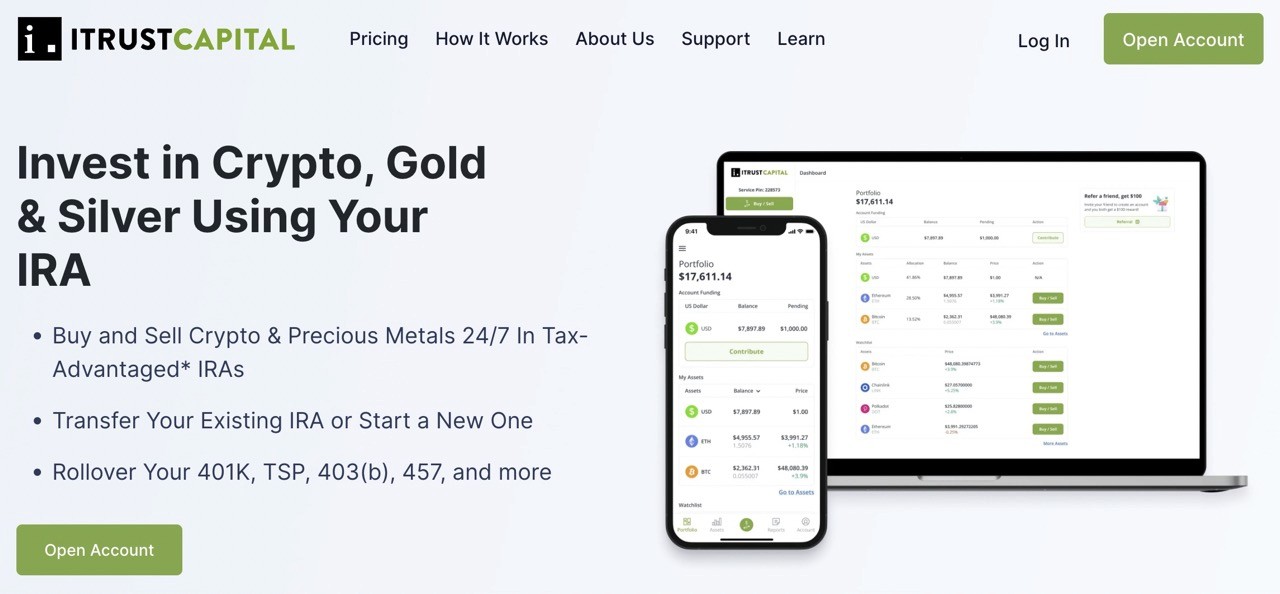
Introduction: What is iTrustCapital Wallet
iTrustCapital Wallet (or more broadly iTrustCapital as a service) is a custodial investment platform that enables investors—mainly in the U.S.—to buy, hold, and manage cryptocurrency or precious metals within either a tax‑advantaged IRA or a standard, non‑retirement account. Unlike typical crypto wallets where users manage their own private keys, iTrustCapital entrusts custody of assets to regulated institutional custodians, providing a mix of convenience, institutional-grade storage, and tax-advantaged investment structure.
This setup simplifies crypto investment for people who prefer not to manage private keys themselves, or who wish to integrate crypto or precious metals into their retirement or long-term investment plans.
Core Features of iTrustCapital
Custody by Qualified Institutions
Assets purchased or held through iTrustCapital are stored under custody by regulated third‑party qualified custodians — not in a wallet controlled directly by the user. This model shifts the responsibility of secure storage and compliance away from the individual investor to established custodial institutions.
IRA-Based Crypto & Metals Holdings
iTrustCapital supports self-directed IRAs (traditional, Roth, etc.), allowing users to hold crypto or precious metals inside a retirement account. This offers potential tax advantages, similar to more traditional retirement investments like stocks or mutual funds.
Taxable (Non‑IRA) Premium Custody Account (PCA) Option
For those who do not want a retirement account, iTrustCapital offers a regular taxable custody account — called a Premium Custody Account — where investors can hold crypto or metals in institutional custody.
No Traditional “Wallet” Access
Because custody is institutional, investors do not receive a private key or traditional wallet that they personally manage. They cannot freely withdraw crypto tokens to an external wallet or hardware wallet. Instead, crypto is held securely by the custodian, and withdrawals (in PCA accounts) are typically processed in fiat (e.g., USD), not as transferable crypto.
Simplified User Experience
From a user’s standpoint, iTrustCapital functions more like an investment or retirement platform than a self‑custody wallet. Users buy, hold, and manage investments via a familiar account‑based interface, without worrying about private key management, seed phrases, or manual wallet security.
How iTrustCapital Works: Process Overview
A user creates an account with iTrustCapital and chooses between an IRA (for retirement) or a taxable Premium Custody Account.
Through this account, the user purchases supported cryptocurrencies or precious metals.
The purchased assets are held in secure custody by a qualified custodian on behalf of the user.
For IRA accounts, assets remain within the regulatory and tax-advantaged framework — the user cannot transfer crypto to an external personal wallet.
For PCA accounts, liquidation or withdrawal happens via fiat conversion, not by moving crypto tokens directly out to a personal wallet.
Because of this structure, iTrustCapital is best understood as a custodial investment service rather than a self-custody wallet.
Pros and Cons of iTrustCapital
Pros
Institutional-grade custody reduces responsibility for security and wallet management.
Allows crypto or metals exposure within a retirement (IRA) or taxable account context.
Avoids the technical challenges and risk of managing private keys or seed phrases.
Streamlines the investment process for users unfamiliar with crypto wallet mechanics.
Cons / Limitations
Users do not control private keys or wallets directly — custody is with external institutions.
Crypto held in PCA cannot be withdrawn to a personal wallet; only fiat withdrawals are allowed.
The model may not appeal to those who value full control over their crypto assets.
Services are typically limited to U.S. investors, which may exclude international users.
Who iTrustCapital Is For — and Who It Isn’t
iTrustCapital is suitable for:
Investors who want exposure to crypto or precious metals without managing private keys.
Individuals who prefer custodial storage for simplicity, security, and institutional oversight.
People seeking to include crypto or metals in retirement (IRA) accounts.
Those who value convenience and compliance over self-custody and decentralization.
iTrustCapital is less suitable for:
Users who want full control of private keys and the ability to move assets freely on blockchain.
Investors who prefer non‑custodial, decentralized wallets or hardware wallets.
Users outside the U.S., or those who need global blockchain flexibility.
Crypto-native users who favor peer-to-peer transfers, DeFi, and direct wallet-to-wallet activity.
Conclusion: Understanding iTrustCapital Wallet
iTrustCapital offers a distinctly different model compared to conventional crypto wallets. It acts as a custody-based investment and retirement platform rather than a self-custody wallet. For people who want to gain exposure to cryptocurrencies or precious metals but prefer the convenience and security of institutional custody — particularly within retirement or taxable investment accounts — iTrustCapital can be an attractive option.
However, its custodial structure and inability to withdraw crypto to personal wallets make it unsuitable for users who value full control, decentralization, or active participation in blockchain ecosystems.
In essence, iTrustCapital fills a niche: a bridge between traditional investment/retirement systems and the crypto world — trading flexibility and control for simplicity, compliance, and convenience.